


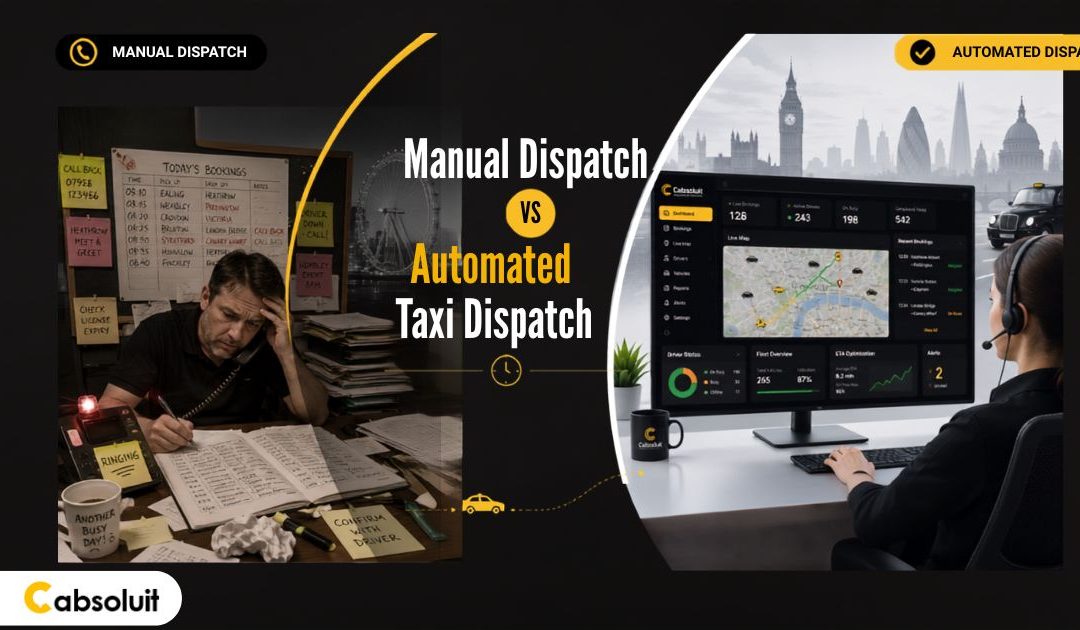
Most UK taxi operators start the same way. A phone rings. A booking is written down. A dispatcher calls a driver. A job gets done.
That process works at small scale. But as bookings grow, drivers multiply and customer expectations rise, the cracks start to show.
What Is Manual Taxi Dispatch?
Manual dispatch means bookings are taken by phone, written into a spreadsheet or shared with drivers by call, radio or message.
It is still common across the UK small taxi firms, private hire operators with low booking volume, school run operators managing repeat routes and airport transfer firms handling advance bookings by phone.
Manual dispatch gives direct control. The dispatcher knows every job, every driver and every route personally. For a 3-vehicle operation with 15 daily bookings, this works.
The problem is not the method. It is what happens when the business grows faster than the process behind it.
What Is Automated Taxi Dispatch Software?
Automated dispatch software connects bookings, drivers, vehicles and dispatchers in one platform.
Bookings arrive through the passenger app, website booking widget, WhatsApp chatbot or phone and all land on one admin portal dashboard. The driver app pushes job details to drivers instantly. GPS tracking shows every vehicle's live position. Recurring bookings run automatically without daily re-entry.
Automation does not remove dispatchers. It helps them work faster with better visibility over every job, driver and vehicle simultaneously.
Manual Dispatch: Where It Still Works
Manual dispatch is not always the wrong choice. It can still work for:
- Very small fleets 5 vehicles or fewer
- Low daily booking volume under 20 jobs per day
- Familiar local customers with predictable journeys
- Simple one-off trips without repeat scheduling
- Operators not yet ready for software investment
The honest answer is that manual dispatch becomes risky when volume grows. Not at once gradually. Small delays, missed messages and duplicate entries accumulate until the process collapses under its own weight.
Where Manual Dispatch Starts to Cost Time
The hidden costs of manual dispatch only become visible when something goes wrong.
As booking volume increases, dispatchers find themselves repeating the same information to multiple drivers. Checking vehicle availability means calling drivers one by one. Advance bookings get lost in a WhatsApp thread.
Duplicate entries appear when two dispatchers log into the same job. Peak periods Friday nights, school run mornings; airport pickup windows expose every gap in the process.
In the UK specifically, these pressure points are significant. A school run was missed because a dispatcher was on a call with another driver. An airport transfer late because nobody confirmed the driver assignment.
These are not rare scenarios. They are daily realities for operators managing 20 or more vehicles without the right system behind them. Manual dispatch does not fail at once. It slowly creates small delays that add to lost bookings and lost customers.
How Automated Dispatch Saves Time
Jobs are created and assigned faster dispatchers are not re-entering the same booking every morning. Drivers receive full job details on their app at the moment a booking is confirmed. GPS tracking eliminates the constant "where are you?" calls that consume dispatcher time during busy periods.
A practical example: a school run booked every weekday does not need to be recreated every morning. With Cabsoluit's recurring bookings, the dispatcher sets the route once and manages exceptions only when something changes a student absent, a school closure, a driver unavailable.
Website and app bookings land directly in the dispatch dashboard without manual entry. No typing. No phone call. No risk of a missed message.
Manual vs Automated Dispatch: Key Differences
|
Feature |
Manual dispatch |
Automated dispatch |
|
Booking creation |
Phone call, manual entry |
App, web, WhatsApp — automatic |
|
Driver assignment |
Dispatcher calls drivers |
System assigns instantly |
|
Vehicle tracking |
Phone calls to check |
Live GPS map |
|
Advance bookings |
Spreadsheet or memory |
Scheduled and automated |
|
Customer updates |
Manual call or message |
Automatic notifications |
|
Error risk |
High – dependent on people |
Low – system-led |
|
Scaling |
Requires more staff |
Handles more volume, same team |
Cost Savings: Where Automation Makes the Difference
Cost saving from automated dispatch is not only about the software price. It is about what you stop spending.
Less dispatcher time wasted on repeat calls. Fewer missed or duplicate bookings. Better driver utilization vehicles move when they should, not when a dispatcher finally gets through to confirm. Less fuel waste from poor job allocation. Fewer customer complaints from late or missed pickups.
Most importantly: more bookings handled without hiring additional office staff.
The right taxi dispatch software reduces operational pressure. It should not add complexity.
Why This Matters for UK Taxi and Private Hire Operators
UK operators are managing rising fuel costs, driver shortages and customer expectations shaped by Uber and Bolt. Passengers now expect instant booking confirmation, accurate ETAs and live driver tracking.
Council school run contracts require GPS evidence and compliance documentation. Airport transfer clients expect pre-booked pickups to run exactly on time. Corporate accounts need professional reporting and invoicing.
None of this is manageable at scale through a spreadsheet and a phone.
When Should a Taxi Operator Move from Manual to Automated Dispatch?
If any of the following apply to your operation, it is time to consider making the switch:
- You manage more than 10 to 20 vehicles
- Dispatchers are missing calls or messages during busy periods
- Drivers keep asking for job details that should already be confirmed
- School runs or repeat bookings consume too much daily admin time
- You want to grow but cannot hire more office staff
- Customers are complaining about delays or unclear updates
- You cannot clearly see driver and vehicle status at any given moment
These are not signs of poor management. They are signs that the process has outgrown the tools behind it.
How Cabsoluit Helps Operators Automate Dispatch
Cabsoluit gives UK taxi and private hire operators one system to manage bookings, drivers and vehicles with less manual work.
The platform covers automated dispatch, live GPS tracking, driver app, passenger app, admin portal, website booking widget, recurring bookings, fleet visibility and multi-channel booking support from one dashboard.
Small fleets and large fleets alike use it to reduce the daily admin load without adding headcount.
Conclusion
Manual dispatch can work for very small fleets. But as bookings, drivers and customer expectations grow, it creates delays that cost time and money.
Automated taxi dispatch software reduces manual entry, improves driver visibility and helps operators manage more work with the same team.
If your taxi business is spending too much time on manual dispatch, Cabsoluit can help you move to a smarter, more organized dispatch system. Try it free for 14 days no setup fees, no long-term contracts.