


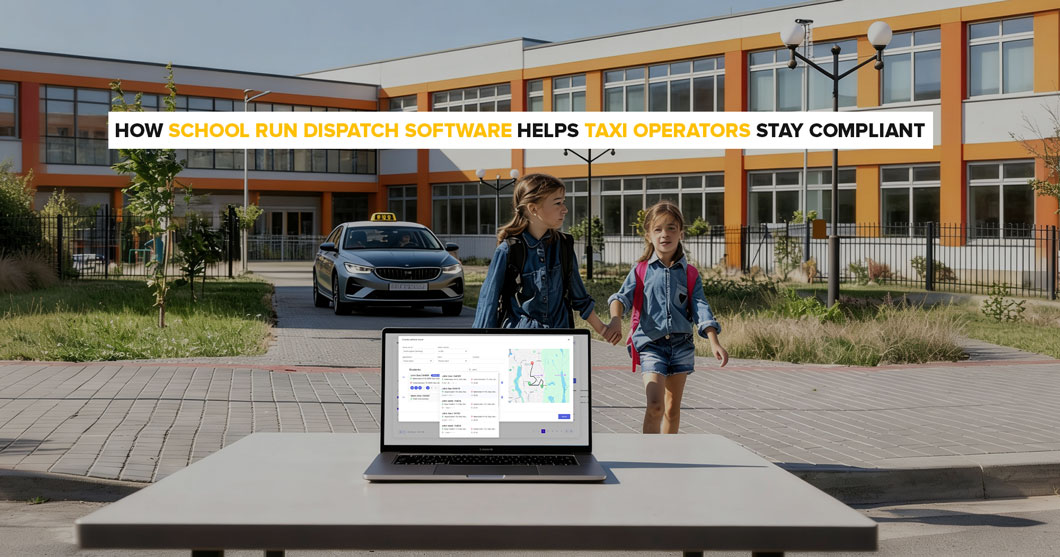
It keeps driver records, recurring journeys, student pickup notes, assigned drivers, route visibility, completion logs, parent/school communication, and incident notes in one place.
This is important because school runs are not normal taxi jobs. They often involve children, daily routes, fixed pickup times, parents, schools, councils, and extra care needs.
The software does not replace legal checks or local council rules. But it helps taxi companies stay organized, reduce mistakes, and prove what happened on each journey.
In the UK, home-to-school travel guidance is mainly written for local authorities. But the guidance also says it may be useful for schools, parents, and transport operators involved in school travel.
- Why Compliance Matters in School Run Taxi Work
- 1. Driver Records Help Operators Stay Organised
- 2. Recurring Journeys Reduce Manual Mistakes
- 3. Student Pickup Notes Help Drivers Follow the Right Steps
- 4. Assigned Drivers Make School Runs More Consistent
- 5. Route Visibility Helps the Office Track What Is Happening
- 6. Completion Logs Give Proof of Each Journey
- 7. Parent/School Communication Keeps Everyone Updated
- 8. Incident Notes Help Operators Record Problems Clearly
- How Dispatch Software Supports Safeguarding Processes
- Manual Records vs School Run Dispatch Software
- Key Features to Look for in School Run Dispatch Software
- Compliance Benefits for Taxi Operators
- Common Mistakes Taxi Operators Should Avoid
- How Cabsoluit Helps Taxi Operators Manage School Runs
- Final Thoughts
- FAQs
Why Compliance Matters in School Run Taxi Work
School transport is sensitive work. A taxi operator is not only taking someone from one place to another. The operator may carry children every day. Some students may have special needs. Some may need a regular driver. Some may need a clear handover at home or school.
This means the taxi company must know:
- Who is driving?
- Which student is being picked up?
- Where is the pickup point?
- What time was the child collected?
- Was the child dropped off safely?
- Was there a delay, no-show, or incident?
If these details are not recorded, it becomes hard to answer questions later. A parent may call about a late pickup. A school may ask which driver attended. A council may need proof that a route was completed. In these cases, clear records matter. That is where school run dispatch software helps.
1. Driver Records Help Operators Stay Organised
Driver records are one of the most important parts of school transport compliance. A taxi operator should be able to check which driver is linked to each school route. The office should also know if a driver is approved for that type of work.
A driver record may include:
- Driver’s name.
- Badge or licence number.
- Vehicle details.
- Contact details.
- Training notes.
- Document expiry dates.
- Assigned school routes.
This does not replace licensing checks. It simply helps the business keep records in one place.
The Department for Transport’s taxi and private hire standards focus on protecting children and vulnerable adults. They also support stronger safety standards across the trade.
For school runs, this matters a lot.
If a school asks who drove a child on a certain day, the operator should not need to search through paper files, call logs, or staff messages.
The answer should be easy to find.
2. Recurring Journeys Reduce Manual Mistakes
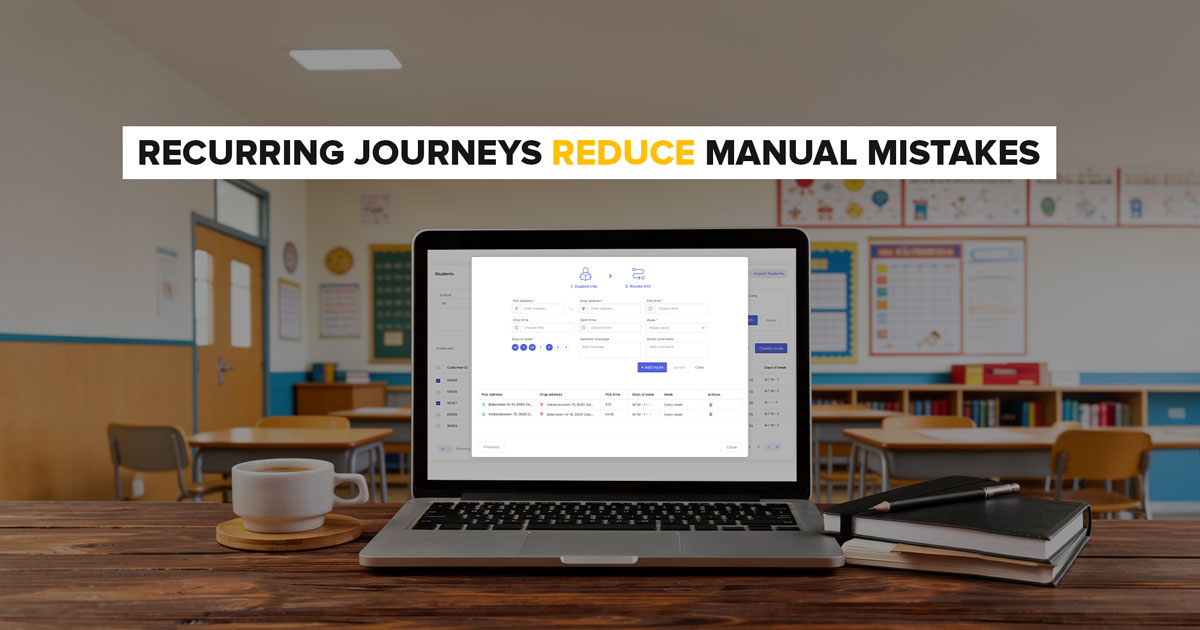
The same child may need a pickup every Monday to Friday. Another student may need a different time on certain days. Some routes may stop during school holidays.
If the office enters these jobs by hand every day, mistakes can happen.
A time may be entered wrong. A student may be missed. A driver may be assigned the wrong route.
Recurring journeys help reduce this risk.
With school run dispatch software, the office can create a repeat journey once and use it across the term.
This can include:
- Morning pickup.
- Afternoon return.
- Term-time schedule.
- Half-day pickup.
- Holiday pauses.
- Route change.
- Temporary driver cover.
Recurring journeys saves admin time. But more than that, they help the operator keep a clear and steady process.
For school transport, this is a compliance benefit.
A missed school run is not just a missed booking. It can affect a child, a parent, a school, and a council contract.
3. Student Pickup Notes Help Drivers Follow the Right Steps
Student pickup notes give drivers the details they need for each child or route. These notes should be simple, useful, and safe to store.
They may include:
- Pickup point.
- School gate or entrance.
- Handover instructions.
- Parent or guardian contact rules.
- Support is needed for the journey.
- Escort requirement.
“Do not leave unattended” note.
Driver arrival instructions.
For example, a student pickup note may say:
“Use the side gate near reception.”
Or:
“Student must be handed to a named adult.”
These small notes can prevent big problems.
Drivers should not have to guess. The office should not rely on memory. Important journey details should be clear before the driver starts the route.
But operators should also be careful with student data.
Only store details that are needed for the journey. Keep sensitive notes limited. Make sure the right people can see them.
The ICO says data protection by design means privacy should be considered from the start, with suitable steps in place to protect people’s rights.
This is very important when records involve children.
4. Assigned Drivers Make School Runs More Consistent
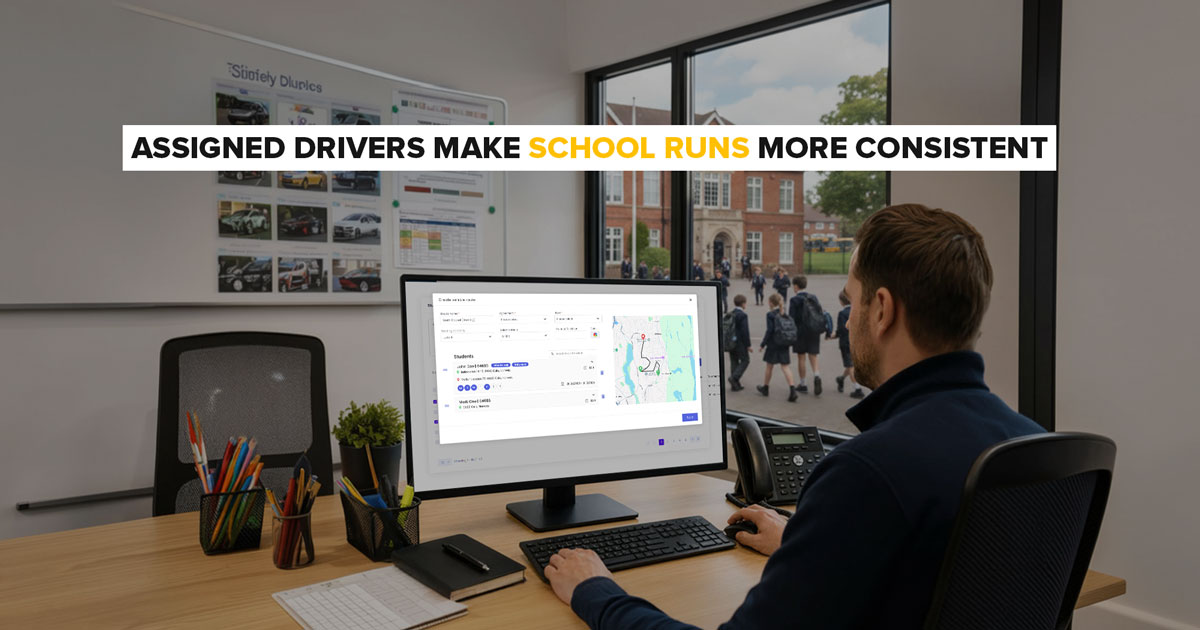
Many students feel more comfortable when they see the same driver. Parents and schools also prefer clear driver details.
With assigned drivers, the office can see who is responsible for each journey.
This helps with:
- Daily planning.
- Driver accountability.
- Parent updates.
- School updates.
- Route cover.
- Driver changes.
- Complaint checks.
If a driver is off sick, the system can show who covered the journey instead. This creates a better record.
It also helps the operator avoid confusion when many school runs happen at the same time. In school transport, consistency matters.
It helps children feel safe. It helps parents trust the service. It helps managers keep control.
5. Route Visibility Helps the Office Track What Is Happening
Route visibility means the taxi office can see where school vehicles are and what stage each journey is at.
This may include live driver location, active jobs, pickup status, drop-off status, and route progress.
This is useful when a parent calls and asks:
“Where is the driver?”
Or when a school asks:
“Has the child left yet?”
Without route visibility, the office may need to call the driver. This can slow everything down.
With school run dispatch software, the dispatcher can check the system first.
Route visibility helps the operator spot delays early.
For example, traffic, roadworks, bad weather, or a vehicle issue may affect the route. If the office can see the delay, they can update the parent or school sooner.
This improves communication skills. It also helps the business keep a record of what happened.
6. Completion Logs Give Proof of Each Journey
Completion logs are very important for school transport.
A completion log shows that a journey was done. It may show pickup time, drop-off time, driver name, route status, and notes.
This gives the operator a clear journey history.
If a parent, school, or council asks about a trip, the operator can check the record.
A completion log can help answer:
- Was the student picked up?
- What time was the pickup?
- Was the journey completed?
- Was the student dropped off?
- Was there a no-show?
- Was the route delayed?
- Was the job cancelled?
This is much better than relying on memory.
For example, if a parent says the driver was late, the office can check the journey log. If a school says a student did not arrive, the operator can check the route record and speak to the driver with facts.
Completion logs do not only protect the business.
They also help improve service quality.
If the same route is late often, the manager can review the pickup time, driver plan, or route order.
7. Parent/School Communication Keeps Everyone Updated
Good parent/school communication is a big part of school run transport.
Many complaints happen because people do not know what is happening.
A parent may worry if the taxi is late. A school may need to know if a child has not been collected. A council may need an update if a route changes.
School run dispatch software can help keep messages and notes in one place.
This may include:
- Delay updates.
- Pickup confirmation.
- Drop-off confirmation.
- Driver change notes.
- School office messages.
- Parent contact notes.
- Incident follow-up.
- This makes the process clearer.
It also stops information from being lost across phone calls, WhatsApp messages, driver texts, and paper notes.
The goal is simple. The right person should get the right update at the right time.
Clear communication helps parents feel calm. It helps schools plan better. It helps the taxi operator look professional.
8. Incident Notes Help Operators Record Problems Clearly
Even with good planning, problems can happen. A student may not be ready. A parent may not be at the pickup point. The road may be closed.
A child may become upset during the journey. A driver may report a concern. Incident notes help the operator record these events.
A good incident note should be factual.
It should include:
- What happened.
- Date and time.
- Driver’s name.
- Student or route reference.
- Location.
- Action taken.
- Who was told.
- Follow-up is needed.
- Avoid guesses. Avoid emotional wording. Keep it clear.
For example:
“Driver arrived at 8:05 AM. Student was not at pickup point. Office called parent at 8:08 AM. Parent confirmed student was absent. Journey marked as no-show.”
This type of note is useful. It gives the office a record. It helps managers review patterns. It may also help schools or councils understand what happened.
For serious concerns, operators should follow their safeguarding process and contract rules. Software can help store notes. But people still need to take the right action.
How Dispatch Software Supports Safeguarding Processes
Safeguarding is a key part of school transport. Software cannot replace training. It cannot replace good judgement. It cannot replace local rules. But it can support safer work.
It does this by giving the taxi operator a clear record of drivers, routes, journeys, and incidents.
The Department for Transport’s best practice guidance says licensing authorities should consider safeguarding training so drivers can understand how to protect children and vulnerable adults and report concerns.
School run software can support this by helping operators manage:
- Approved drivers.
- Assigned routes.
- Student pickup notes.
- Journey history.
- The driver changes.
- Incident notes.
- Communication logs.
This makes it easier for managers to check what happened.
It also helps build a safer working process.
In school transport, compliance is not only about having the right driver and vehicle. It is also about keeping a clear record of every journey, every driver change, every delay, every pickup note, and every incident.
Manual Records vs School Run Dispatch Software
Many taxi operators still use spreadsheets, paper notes, phone calls, and WhatsApp messages.
This may work for a small number of jobs.
But it becomes risky when the company manages many school runs.
Here is a simple comparison.
| Area | Manual Process | School Run Dispatch Software |
|---|---|---|
| Driver records | Stored in files or spreadsheets | Stored in one system |
| Recurring journeys | Entered again and again | Set once and repeated |
| Student pickup notes | Easy to miss | Shown on the job |
| Assigned drivers | Based on memory or calls | Clearly linked to routes |
| Route visibility | Limited | Live or logged route view |
| Completion logs | Written by hand | Saved as digital records |
| Parent/school communication | Spread across channels | Stored in one place |
| Incident notes | Paper or messages | Searchable history |
The operator can see what is planned, what is active, what is complete, and what needs attention.
Key Features to Look for in School Run Dispatch Software
Not every taxi dispatch system is built for school runs.
A good system should help with daily control, records, and communication.
Look for these features:
- Driver record management.
- Recurring journey setup.
- Student pickup notes.
- Assigned driver control.
- Route visibility.
- Completion logs.
- Parent/school communication tools.
- Incident notes.
- Driver app.
- Admin dashboard.
- Reporting tools.
- Data export.
- User access controls.
- Secure data handling.
The best system is not always the one with the most features. The best system is the one that helps your office run school routes safely, clearly, and consistently.
Compliance Benefits for Taxi Operators
- School run dispatch software can help taxi operators in many ways.
- It can reduce missed pickups.
- It can help the office respond faster.
- It can improve parent and school trust.
- It can give managers better records.
- It can make council reporting easier.
- It can help with complaint handling.
- It can improve driver’s accountability.
- It can also support contract management.
Councils and schools want operators they can trust. They want safe transport, clear records, and fast updates.
If your taxi company can show strong systems, it may help you protect your reputation and build better relationships.
Common Mistakes Taxi Operators Should Avoid
School run work needs care. Here are common mistakes to avoid.
1. Using WhatsApp as the Only Record
WhatsApp is useful for quick updates. But it should not be the only record system. Messages can be missed, deleted, or stored on personal phones. Important school run records should live in a proper system.
2. Not Recording Driver Changes
If a regular driver is replaced, the change should be recorded. The office should know who completed the journey. This helps with safety, communication, and audit checks.
3. Not Updating Student Pickup Notes
Pickup details can change. The school gate may change. A parent contact rule may change. A student may need a new handover process. Old notes can cause mistakes. Review student pickup notes often.
4. Not Saving Completion Logs
If completion logs are missing, the operator may struggle to prove what happened. Every school journey should have a clear status. Completed. Cancelled. No show. Delayed.
5. Not Recording Incidents Properly
Incident notes should be clear and factual. Do not write vague notes like “problem with student.” Write what happened, when it happened, and what action was taken.
6. Storing Too Much Student Data
Only store what the driver and office need for the journey. Too much personal information can create risks. Keep notes useful and limited.
How Cabsoluit Helps Taxi Operators Manage School Runs
Cabsoluit helps taxi operators manage school run work from one dispatch system. It supports the key areas that matter in daily school transport.This includes recurring journeys, assigned drivers, route visibility, completion logs, student pickup notes, parent/school communication, and incident notes.
For office teams, this means less manual work. For drivers, it means clearer job details. For managers, it means better records and more control. For parents and schools, it means better updates and fewer gaps in communication.
Cabsoluit is built to help taxi companies run school transport in a more organized way. It helps operators move away from scattered records and daily manual booking work.
Final Thoughts
School run dispatch software helps taxi operators manage compliance by keeping key records in one place.
It supports driver records, recurring journeys, student pickup notes, assigned drivers, route visibility, completion logs, parent/school communication, and incident notes.
It does not replace legal duties, licensing rules, or safeguarding training. But it gives operators a clearer way to manage school transport.
Cabsoluit helps taxi companies manage school routes, driver assignments, journey logs, updates, and incident records from one simple dispatch system.