


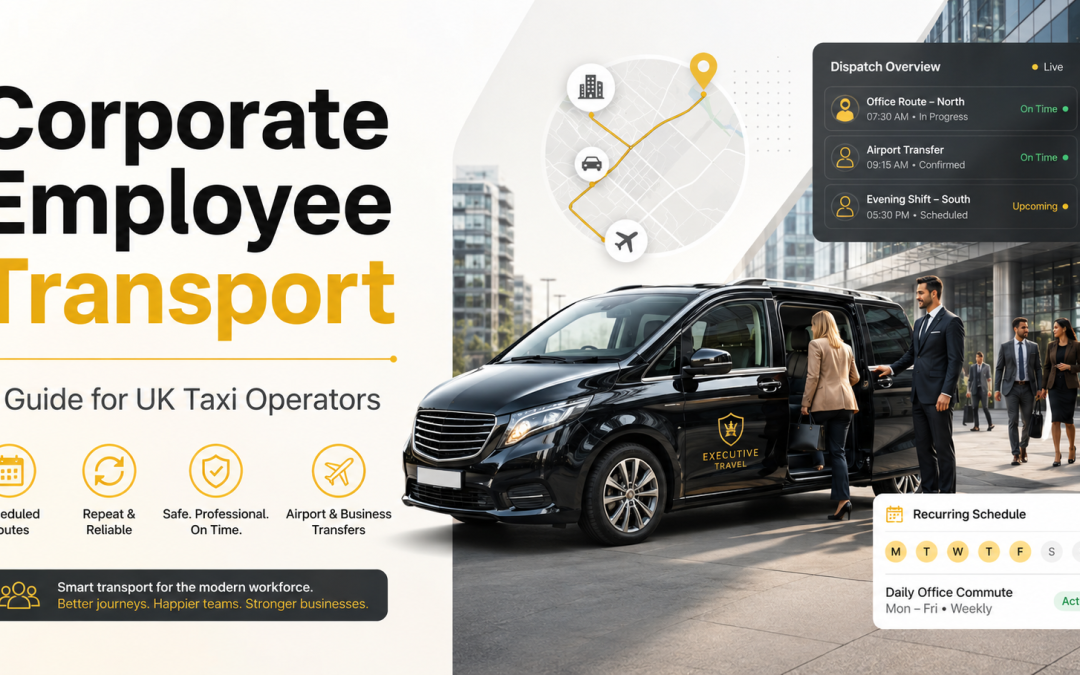
Corporate employee transport is becoming a strong opportunity for UK taxi operators.
Many companies need safe, reliable, and well-managed transport for their staff. This can include daily office travel, late-night employee drop-offs, airport transfers, shift transport, and travel between business sites.
For taxi companies, this is not just another service. It can become a steady revenue stream.
Unlike one-off passenger bookings, corporate transport can bring repeat work, planned schedules, and long-term business contracts. But to win and manage these contracts, operators need more than cars and drivers. They need strong systems, clear processes, and reliable dispatch control.
- What Is Corporate Employee Transport?
- Why Corporate Transport Is a Good Opportunity for Taxi Operators
- What Corporate Clients Expect from Taxi Operators
- The Main Challenges in Corporate Employee Transport
- How Taxi Dispatch Software Helps Corporate Transport
- Why Recurring Bookings Matter for Corporate Clients
- Real-Time Tracking Builds Trust
- Using Driver Apps and Passenger Apps
- How UK Taxi Operators Can Win Corporate Transport Work
- What to Include in a Corporate Transport Proposal
- Conclusion
- FAQs
What Is Corporate Employee Transport?
Corporate employee transport means moving staff for a business or organization.
This can include:
- Daily employee pickups and drop-offs
- Office-to-office travel
- Staff airport transfers
- Late-night transport after shifts
- Event transport for business teams
- Transport for remote work sites
- Regular travel for healthcare, retail, hospitality, and warehouse staff
In the UK, many companies use private hire operators and taxi firms for employee travel because it is flexible. They do not need to own vehicles or manage drivers themselves.
This creates a useful opportunity for taxi operators that already have trained drivers, licensed vehicles, and local route knowledge.
Why Corporate Transport Is a Good Opportunity for Taxi Operators
Corporate clients are different from normal passengers.
A normal customer may book once and never return. A corporate client may need transport every day, every week, or every month.
This gives taxi businesses more predictable work.
For example, a warehouse may need transport for night-shift staff. A hotel may need regular airport transfers for business guests. A healthcare company may need staff moved between sites.
These jobs can help taxi operators:
- Increase repeat bookings
- Reduce empty vehicle time
- Build long-term accounts
- Improve fleet usage
- Plan driver schedules better
- Grow beyond one-off local trips
Corporate employee transport can also help during quieter hours. Some staff travel happens early in the morning, late at night, or outside normal peak demand. This can help operators use vehicles more efficiently.
What Corporate Clients Expect from Taxi Operators
Corporate clients do not only look at price. They want reliability.
If an employee is late because transport fails, it creates a problem for the business. This is why corporate clients care about punctuality, driver standards, booking accuracy, and communication.
Most businesses expect:
- Licensed and insured drivers
- Clean and well-maintained vehicles
- Clear booking confirmation
- Accurate pickup and drop-off details
- Real-time journey updates
- Professional driver behaviour
- Simple invoicing
- Fast support if something changes
For UK taxi operators, this means the service must feel organised. A business client needs confidence that every journey will be handled properly.
The Main Challenges in Corporate Employee Transport
Corporate transport sounds simple, but it can become complex.
One business may have several pickup points, different shift times, multiple departments, and changing passenger lists.
The biggest challenges include:
- Managing repeat journeys
- Handling last-minute changes
- Assigning the right driver
- Tracking vehicle location
- Avoiding missed pickups
- Keeping booking records clear
- Sending accurate invoices
- Managing different business accounts
Manual dispatch can work for a few bookings. But once corporate travel grows, phone calls, spreadsheets, and WhatsApp messages can create errors.
One missed update can affect a full shift pickup. One wrong address can delay a business traveler. One unclear booking note can create confusion for the driver.
This is where taxi dispatch software becomes important.
How Taxi Dispatch Software Helps Corporate Transport
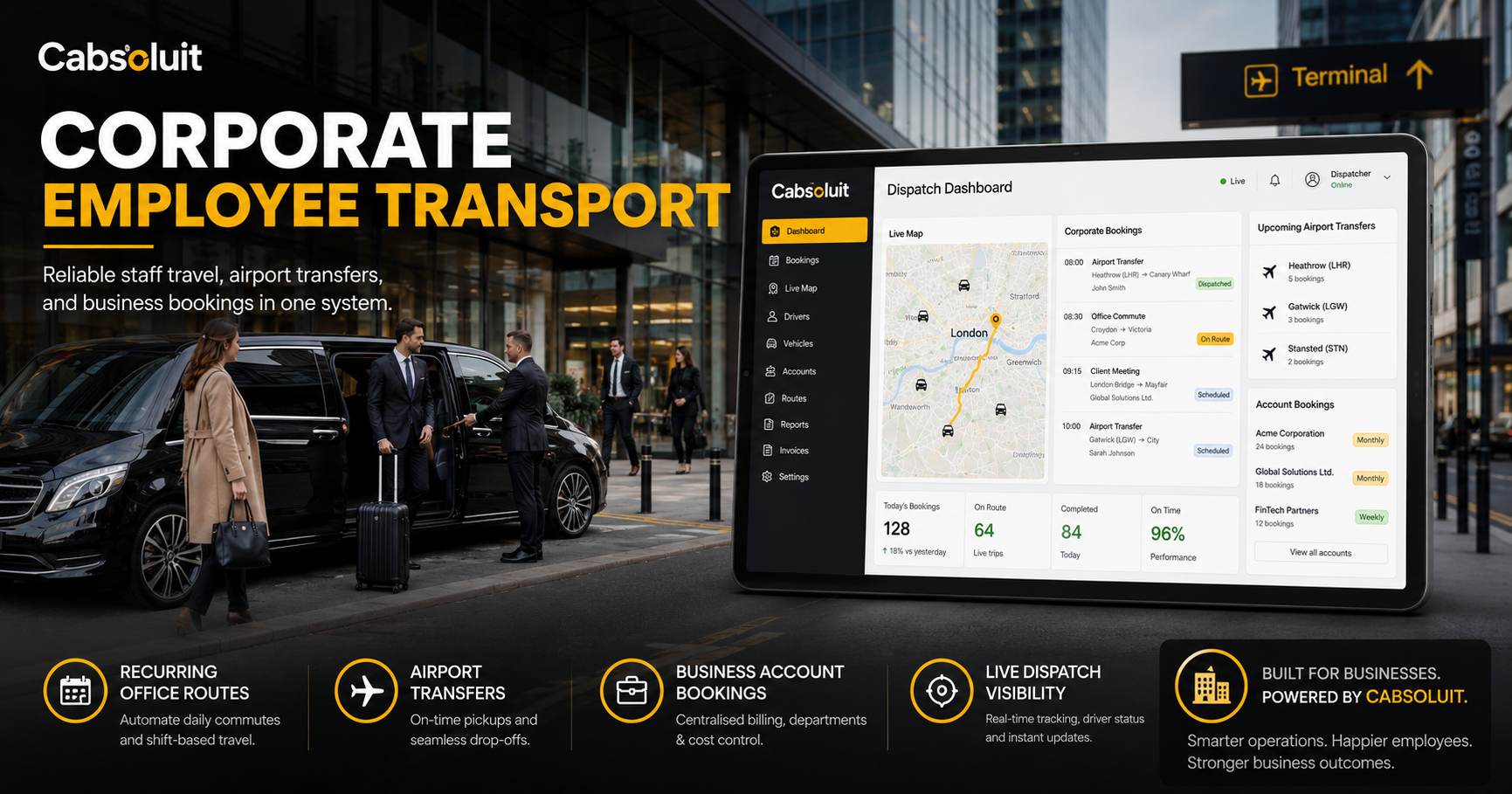
Taxi dispatch software helps operators manage corporate employee transport from one place.
Instead of relying on paper notes or separate messages, bookings can be created, assigned, tracked, and reviewed through a dispatch dashboard.
A system like Cabsoluit can help operators manage:
- Corporate bookings
- Driver allocation
- Vehicle availability
- Real-time GPS tracking
- Recurring journeys
- Passenger details
- Admin control
- Account-based reporting
- Web and app bookings
This makes daily operations easier for dispatchers.
For example, if a company books the same staff transport every weekday, the dispatcher should not have to recreate that booking every morning. With recurring bookings, the journey can be set once and repeated as needed.
This saves time and reduces manual errors.
Why Recurring Bookings Matter for Corporate Clients
Many corporate journeys repeat.
A staff shuttle may run every weekday. A night-shift pickup may happen at the same time each evening. An office transfer may follow the same route each morning.
Recurring bookings make this easier to manage.
The dispatcher can create the journey once, set the schedule, and manage exceptions only when something changes.
This is useful for:
- Shift workers
- Office staff travel
- Hotel staff transport
- Factory workers
- Healthcare teams
- Airport transfer accounts
- Regular business visitors
Recurring bookings reduce repeated admin work. They also give operators better visibility of upcoming demand.
This means managers can plan drivers and vehicles earlier, instead of reacting at the last minute.
Real-Time Tracking Builds Trust
Corporate clients want to know that the ride is under control.
Real-time GPS tracking helps taxi operators show where drivers are, what jobs are active, and which vehicles are available.
For dispatchers, this reduces phone calls.
Instead of asking, “Where are you?” the dispatcher can check the live vehicle location on the map. If a driver is delayed, the team can respond faster.
This helps with:
- Faster issue handling
- Better customer updates
- Improved driver accountability
- Stronger journey visibility
- More reliable service
For corporate transport, visibility is important. Businesses want transport partners who can prove they are in control.
Using Driver Apps and Passenger Apps
A driver app helps drivers receive clear job details.
This can include pickup address, drop-off location, passenger notes, time, payment type, and special instructions.
For corporate employee transport, this matters because small details can be important. A driver may need to collect a staff member from a side entrance, office gate, hotel lobby, or airport pickup point.
A passenger app or branded booking app can also help employees book or manage rides without needing to call the office every time.
For operators using a white-label or branded model, passengers may only see the taxi company’s brand. This keeps the customer relationship with the operator while the dispatch system works in the background.
How UK Taxi Operators Can Win Corporate Transport Work
To win corporate employee transport contracts, taxi operators need to present themselves as reliable business partners.
Start with local opportunities.
Good targets include:
- Hotels
- Offices
- Warehouses
- Factories
- Care companies
- Retail parks
- Event venues
- Airports
- Business parks
- Healthcare providers
When approaching these businesses, focus on the problems they care about.
Do not only say, “We provide taxis.”
Say how you help them:
- Staff get to work on time
- Late-night employees travel safely
- Airport transfers are managed professionally
- Bookings are tracked clearly
- Invoices are simple
- Repeat journeys are organised
- Drivers are licensed and reliable
Corporate clients need transport that reduces stress, not transport that creates more admin.
What to Include in a Corporate Transport Proposal
A strong proposal should be clear and practical.
Include:
- Your service area
- Fleet size
- Vehicle types
- Licensing and insurance details
- Driver standards
- Booking process
- Dispatch system details
- Tracking and reporting options
- Invoicing process
- Emergency contact process
- Pricing structure
If you use taxi dispatch software, mention how it supports the service.
For example, explain that you can manage recurring staff bookings, track vehicles live, assign drivers quickly, and keep journey records organised.
This shows the company that your operation is ready for regular business work.
Conclusion
Corporate employee transport can be a strong growth opportunity for UK taxi operators.
It gives taxi companies a chance to move beyond one-off bookings and build steady business relationships. But success depends on reliability, planning, and operational control.
Manual systems can quickly become difficult when corporate bookings grow. Taxi dispatch software helps operators manage recurring journeys, driver allocation, GPS tracking, passenger details, and daily dispatch from one place.
For UK private hire operators, corporate transport is not only about providing a ride. It is about giving businesses a transport partner they can trust.
Cabsoluit helps taxi operators manage corporate bookings, automate dispatch, track vehicles, and run fleet operations with better control.