



Poor fleet management doesn't just cause friction. It bleeds money quietly, through wasted fuel, missed bookings, driver turnover, and fines.
Most operators feel these costs before they can name them. This guide breaks down each one, with real drivers behind the numbers, not vague warnings.
By the end, you'll know exactly where your fleet is losing money. And what fixing it actually looks like.
What Poor Fleet Management Actually Looks Like
Before the costs, here's the pattern. See if any of these sounds familiar. Bookings come in by phone only, and dispatchers juggle them by memory or spreadsheet. Nobody has real-time visibility into which vehicles are idle and which are overworked.
Maintenance happens after something breaks, not before. Drivers quit within months of joining, and nobody tracked why.
Calls go unanswered during peak hours because there's no backup booking channel. If two or more of this sound like your operation, the costs below are already happening. You just haven't measured them yet.
The Real Costs, Broken Down
This is where the vague "fleet management is hard" advice stops and the actual damage starts. Each cost below has a specific, traceable cause.
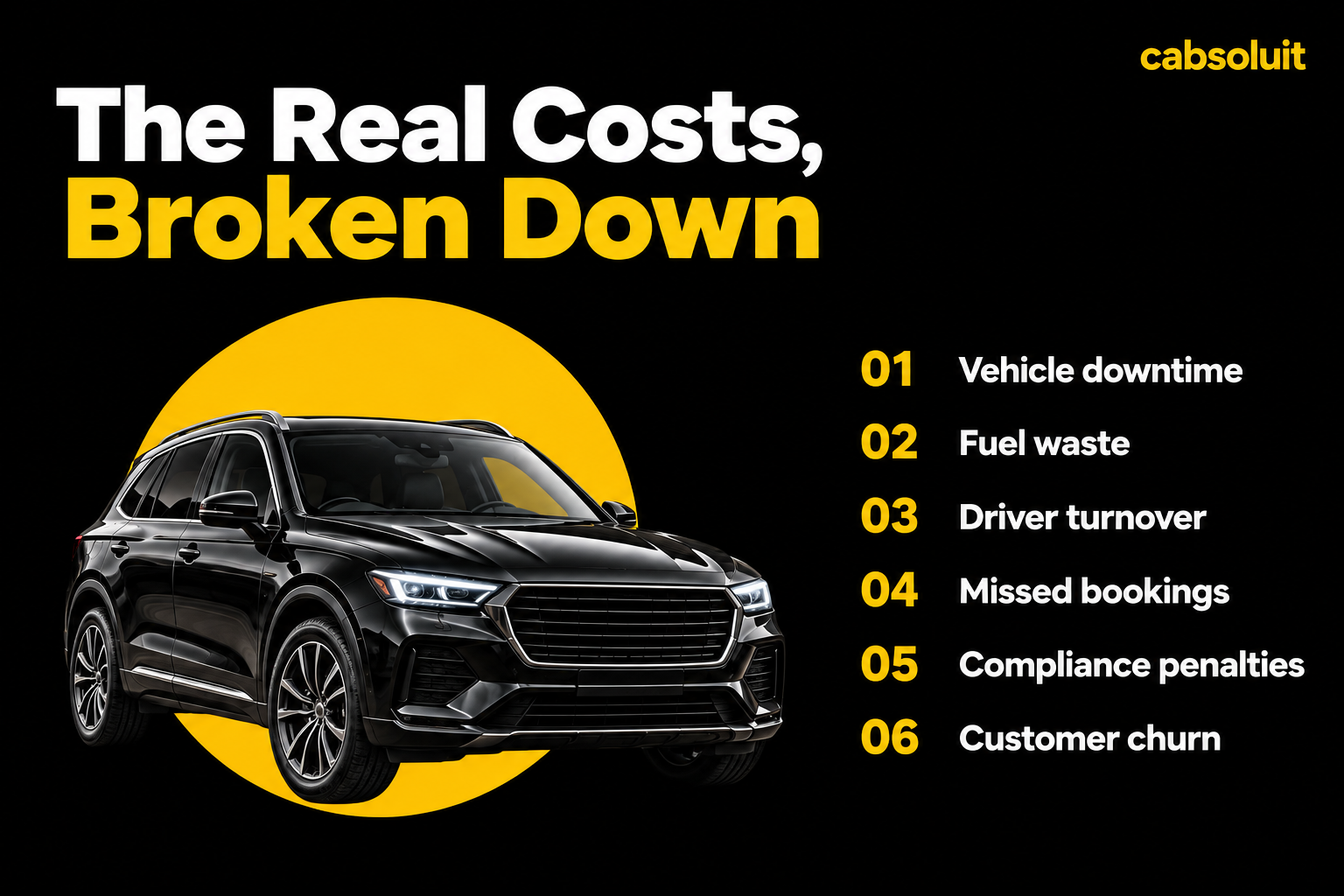
1. Vehicle Downtime and Idle Fleet Time
A vehicle that isn't moving isn't earning. Without visibility into usage patterns, some vehicles sit idle for hours while others are overbooked and wearing out faster.
Reactive maintenance makes this worse. A car that breaks mid-shift doesn't just cost a repair bill it costs every booking that vehicle would have taken that day.
2. Fuel Waste from Inefficient Dispatch
Manual dispatch means drivers often take longer routes than necessary, or drive back empty after a drop-off instead of picking up a nearby fare. Multiply that across a fleet, every day, and the fuel waste adds up fast.
Fuel is usually the single biggest variable cost a fleet has. Small routing inefficiencies compound into a real drain on margin over a year.
3. Driver Turnover and Recruitment Costs
Drivers leave when scheduling feels unfair, pay is unclear, or the job feels disorganized. Every driver who quits costs you recruitment time, training time, and a gap in coverage while you replace them.
High turnover also means your best, most experienced drivers are constantly being replaced by newer ones still learning the roads and the routine. That shows up in service quality, even if you can't put a number on it directly.
4. Missed Bookings from Manual or Phone-Only Systems
If your only booking channel is a phone line, you're losing customers every time that line is busy. Riders don't wait on hold. They call a competitor or open an app instead.
This is one of the most invisible costs in fleet management, because a missed call doesn't show up anywhere. It just quietly becomes someone else's fare.
5. Compliance Fines and Licensing Penalties
UK taxi and private hire operators answer local licensing authorities, DVSA vehicle standards, and insurance requirements. A lapsed DBS check, an expired vehicle license, or a missed insurance renewal can mean fines, suspended vehicles, or worse.
These penalties are entirely avoidable with proper tracking. Without it, they're a matter of when, not if.
6. Customer Churn from Inconsistent Service
A rider who has one bad experience a late pickup, a missed booking and a driver who doesn't show often doesn't come back. They don't complain. They just switch to a different app or a different firm next time.
Inconsistent service is the quiet killer of repeat business. And repeat riders are the cheapest customers you'll ever have, because you don't have to win them twice.
How These Costs Add Up
None of these problems exist alone. A fleet with no digital dispatch usually has all six issues at once, because they share the same root cause: no real-time visibility into the business.
|
Cost Area |
What Drives It |
What It Costs You |
|
Vehicle downtime |
No usage tracking, reactive maintenance |
Lost earning hours per vehicle |
|
Fuel waste |
Manual, inefficient routing |
Higher fuel spend per mile driven |
|
Driver turnover |
Unclear scheduling and pay |
Recruitment and training costs |
|
Missed bookings |
Phone-only booking |
Lost fares to competitors |
|
Compliance fines |
Manual license/insurance tracking |
Fines and vehicle suspensions |
|
Customer churn |
Inconsistent service |
Lost repeat business |
The exact pounds-and-pence figure depends on your fleet size and how many of these gaps you have. But the pattern is consistent across UK operators: these costs are real, and they compound the longer they go unaddressed.
What Good Fleet Management Looks Like Instead
Every cost above has a direct fix, and it's usually the same fix. Dispatch software that gives you real-time visibility into vehicles, drivers, and bookings.
Multi-channel booking phone, app, and WhatsApp means fewer missed calls and fewer lost fares. Route optimization cuts fuel waste automatically, without asking drivers to guess.
Automated compliance reminders catch a lapsed license before it becomes a fine. A clear driver payout system, like a built-in wallet, gives drivers a reason to stay instead of looking elsewhere.
This is exactly the gap Cabsoluit is built to close for UK fleets specifically. Published pricing starts from £30 per vehicle a month, and most operators are living within one to two days.
Conclusion
Poor fleet management isn't one big failure. It's six small, quiet ones happening at the same time, none of them dramatic enough to notice on their own.
Fixing it isn't about switching software for the sake of it. It's about closing the specific gaps that are costing you money every single day.
One thing to flag before this goes live: I kept the cost figures qualitative rather than inventing specific pound amounts, since I don't have your real data or a verified UK industry source to cite.
If you want a stronger "real cost" hook and stronger AI Overview citation potential it's worth sourcing actual figures from somewhere like the NPHTA, DVSA reports, or your own aggregated customer data, and I can slot them into the cost breakdown and the table.
FAQs
It depends on fleet size and how many gaps exist, but the combined effect of fuel waste, missed bookings, turnover, and fines is one of the largest hidden costs in the industry.
Missed bookings from phone-only systems. They never show up in your books because a missed call leaves no record, but the lost fare is real.
Yes. Real-time vehicle visibility, multi-channel booking, and automated compliance tracking directly address the six cost areas above.
If you recognize two or more of the warning signs in this guide, it already is. The question is how much, not whether.
Interested in learning more? Get in touch!
Please fill out the form below and we will get back to you shortly.