


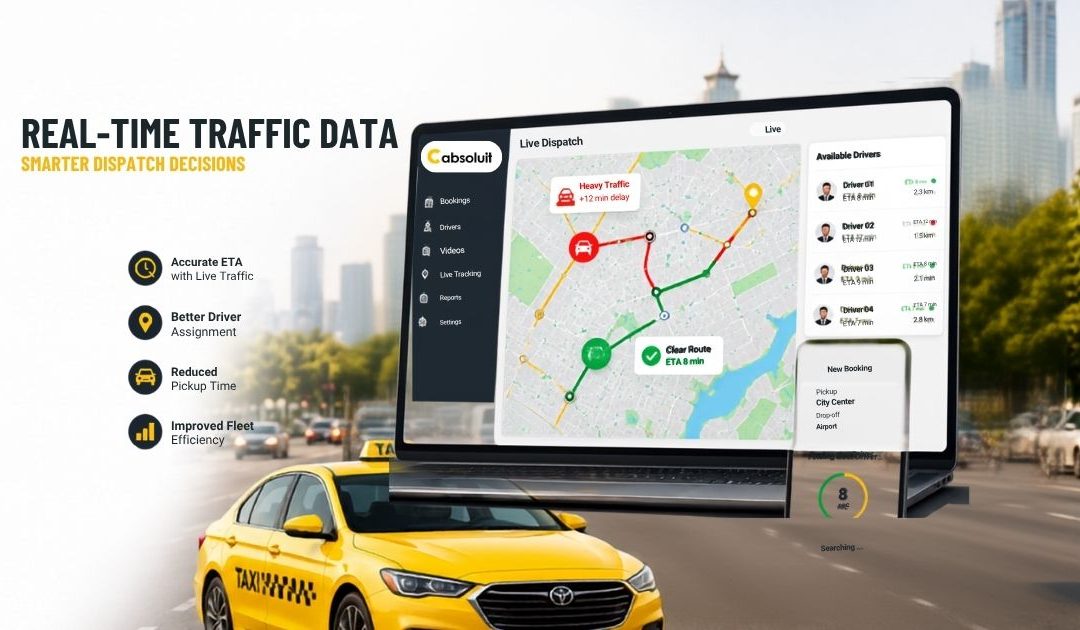
Traffic can change a taxi journey in minutes. A driver who is only a few streets away may still take longer to reach a passenger if the route is congested.
This is why modern taxi dispatch software should look beyond distance when assigning rides. Real-time traffic data, GPS location, driver availability, and estimated arrival time can help operators make better dispatch decisions.
In simple terms, the best driver is not always the closest driver. A driver who is slightly farther away may reach the passenger sooner because of better traffic conditions.
- Why Distance Alone Is Not Enough for Taxi Dispatch
- How Real-Time Traffic Data Works with Dispatch Software
- How Traffic-Aware Dispatch Improves Taxi Operations
- What Should a Taxi System Consider Traffic?
- Real-Time Traffic Data During Peak Hours
- Real-Time Traffic Data and Driver Reassignment
- How Cabsoluit Can Support Traffic-Aware Dispatch
- Key Benefits for Taxi Operators
- Conclusion
- FAQs
Why Distance Alone Is Not Enough for Taxi Dispatch
1. The Closest Driver May Not Be the Fastest
Traditional dispatch rules often focus on finding the nearest available vehicle. This can work well when roads are clear, but distance does not tell the whole story.
A driver may be close to the pickup point but face:
- Heavy traffic
- Road closures
- Accidents
- One-way roads
- Restricted routes
A driver who is further away may have a faster and clearer route.
For this reason, ETA can be more useful than distance alone when deciding which driver should receive a booking.
Example: (Two Drivers, Different Routes)
Imagine a customer needs a taxi from the city center.
Driver A is 1.5 miles away but is stuck in heavy traffic.
Driver B is 2.5 miles away but has a clear route.
A dispatch system that only looks at distance may choose Driver A. But a system that considers estimated travel time may identify Driver B as the better option.
This small difference can reduce customer waiting time and improve fleet efficiency.
How Real-Time Traffic Data Works with Dispatch Software
1. Collecting Live Traffic Information
A modern dispatch system can combine several types of information to understand current road conditions.
This can include:
- GPS location of vehicles
- Current traffic conditions
- Road speeds and delays
- Road closures and incidents
The system can then use this information when making dispatch decisions.
2. Calculating a More Accurate ETA
ETA means an estimated time of arrival. It tells the operator and customer how long a driver is expected to take to reach the pickup point.
Distance alone cannot provide a complete picture.
For example, two drivers may both be two miles from a passenger. One may have an ETA of five minutes while the other takes 12 minutes because of traffic.
Combining GPS location with current road conditions gives the dispatch system a better basis for calculating arrival time.
3. Using Traffic Data During Driver Assignment
When a new booking arrives, the system can compare suitable drivers based on more than their location.
It can consider:
- Where each driver is located
- Whether the driver is available
- How long each driver may take to reach the passenger
- Whether the vehicle meets the booking requirements
This allows the system to select a driver based on the overall situation rather than simply choosing the vehicle shown closest on the map.
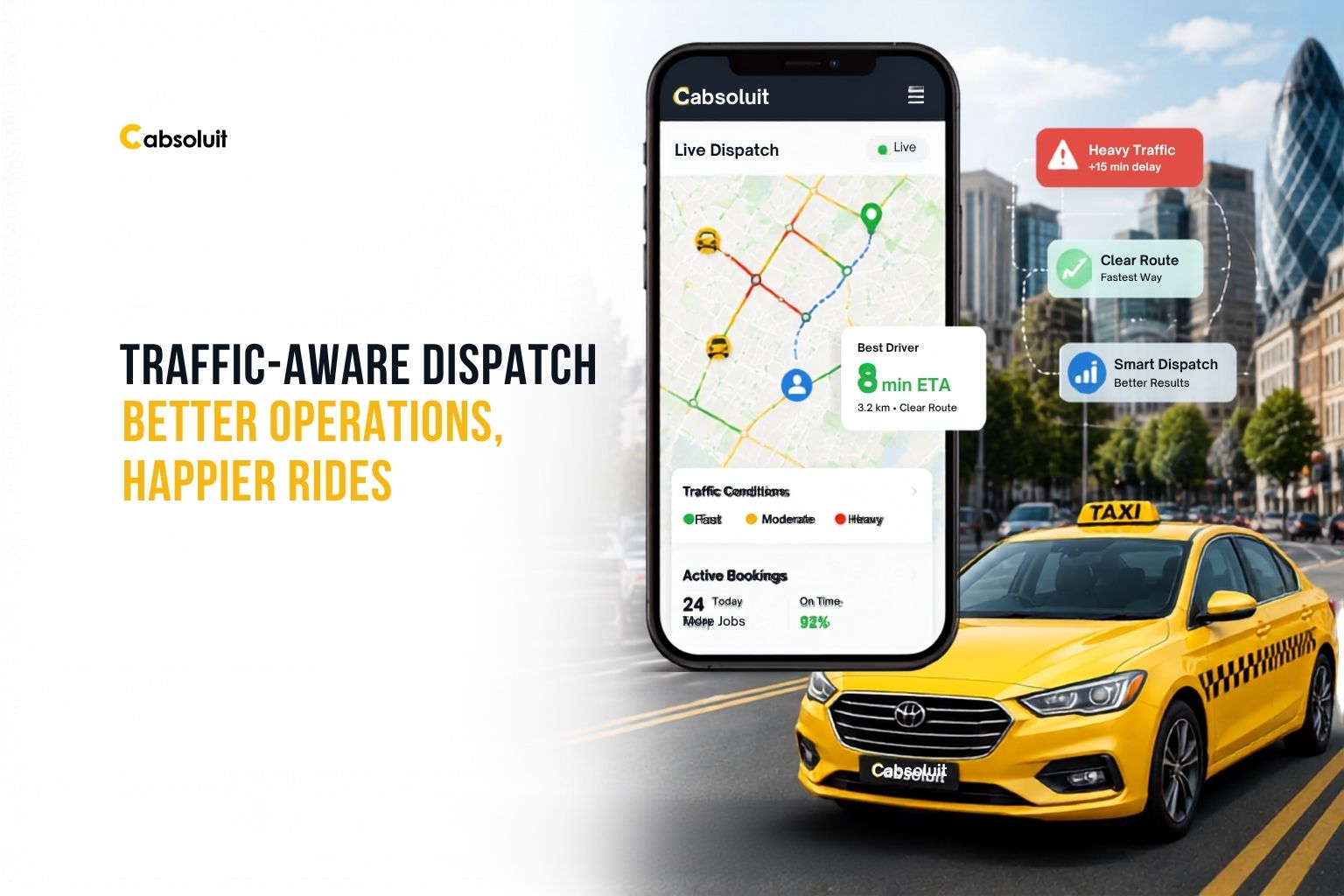
How Traffic-Aware Dispatch Improves Taxi Operations
1. Faster Driver Arrivals
Traffic-aware dispatch can help operators select drivers who are more likely to reach passengers quickly.
This can reduce unnecessary pickup delays and make the dispatch process more efficient.
2. More Accurate Customer ETAs
Customers want to know when their taxi will arrive. Real-time traffic information can help produce more useful ETAs because the calculation considers current road conditions rather than relying only on distance.
3. Fewer Empty or Unproductive Trips
Better route decisions can help reduce unnecessary driving.
For example, sending a nearby driver who is trapped in traffic may create a longer wait and an inefficient trip. Selecting another suitable driver with a better route can make better use of the fleet.
4. Better Fleet Utilization
A taxi fleet works best when vehicles are used efficiently. Traffic-aware dispatch gives operators another layer of information when deciding which driver should handle each booking. This becomes especially useful when many bookings arrive at the same time.
What Should a Taxi System Consider Traffic?
Traffic is important, but it should not be the only factor. A reliable taxi dispatch system should also consider:
- Driver availability
- Vehicle type
- Booking priority
- Pickup zone
- Driver's current trip
- Customer requirements
- Estimated arrival time
For example, the closest driver may not have the right vehicle for a wheelchair passenger. Another driver may be slightly further away but have the required vehicle.
Expert insight: Good dispatching is about finding the most suitable driver, not simply the nearest driver.
Real-Time Traffic Data During Peak Hours
Traffic-aware dispatch becomes even more useful during busy periods.
Morning and evening rush hours can create significant delays. Events, busy shopping areas, roadwork, and airport traffic can also affect journey times.
Taxi operators can use historical booking and traffic patterns to understand when certain areas are likely to become busy.
They can then position available drivers closer to areas where demand is expected to increase.
This is more effective than waiting for bookings to arrive and then trying to move drivers into busy areas.
Real-Time Traffic Data and Driver Reassignment
Traffic conditions can change after a driver has already accepted a booking. An accident or road closure could suddenly make the original route much slower. In such situations, dispatch software can help operators identify major delays and decide whether reassignment is appropriate.
However, reassignment should not happen every time traffic changes. Constantly moving bookings between drivers can create confusion.
The decision should consider the expected delay, the availability of another suitable driver, and the impact on the customer.
How Cabsoluit Can Support Traffic-Aware Dispatch
Cabsoluit brings key dispatch operations together in one system. Its real-time vehicle tracking gives operators visibility into driver locations, while GPS data helps show where vehicles are during active journeys.
Combined with booking information and automated driver assignment, these tools give operators the information they need to make faster dispatch decisions.
Cabsoluit also provides a driver app, allowing drivers to receive booking information and manage their trips from their mobile devices.
For taxi operators, the goal is not simply to put more vehicles on the road. It is to make better use of the vehicles already available.
Key Benefits for Taxi Operators
Using real-time traffic information as part of the dispatch process can help taxi businesses achieve:
- Faster driver arrivals
- More useful ETA information
- Better fleet efficiency
- Less unnecessary mileage
- Improved customer experience
- Better-informed dispatch decisions
The biggest benefit is better decision-making. Operators can use current information instead of relying only on fixed rules or manual estimates.
Conclusion
Distance is useful when assigning a taxi, but it does not always identify the best driver.
Real-time traffic data adds another important layer to the decision. By combining traffic conditions with GPS location, ETA, driver availability, vehicle requirements, and booking priority, a taxi dispatch software system can make smarter assignments.
For growing taxi businesses, this approach can improve fleet utilisation, reduce delays, and provide customers with a more reliable service.
FAQs
Some modern taxi dispatch systems can use traffic and mapping data alongside GPS and booking information to support better driver assignments and ETA calculations.
Traffic can change the actual travel time between a driver and pickup point. A slightly farther driver may sometimes reach the customer faster than the closest driver.
No. Driver availability, traffic, vehicle type, current trips, customer requirements, and ETA can all affect which driver is the best choice.
Yes. Using current traffic conditions alongside vehicle location can provide a more useful ETA than calculating arrival time from distance alone.
GPS tracking shows where vehicles are located and helps operators understand their current position when making dispatch and fleet management decisions.
Interested in learning more? Get in touch!
Please fill out the form below and we will get back to you shortly.