



Licensed Taxi and PHV companies are used by schools, councils and families all over the UK for the safe transportation of children to and from school. There are established routes and timetables. Known passengers. And the contracts usually last for an entire academic year (and sometimes more).
School run contracts are one of the most stable and predictable opportunities in transport, for transport operators looking for stability.
The Reality of School Run Operations
School run transport often looks straightforward from the outside. In practice, it involves fixed routes between pickup points and schools, recurring daily schedules aligned with school hours, multiple passenger groups across different age ranges, and strict compliance with safeguarding and licensing requirements.
As an operator takes on more contracts, the complexity grows quickly.
More routes mean more drivers. More drivers mean more coordination. Many operators still manage these schedules manually through phone calls, spreadsheets and last minute changes. That approach works on a small scale. But as the operation grows, the gaps start to show.
When dozens of children depend on these routes to arrive safely and on time, even small disruptions can have serious consequences.
Councils and schools expect reliability. They want visibility into what is happening, confidence that routes will run on schedule and proof that every driver meets compliance requirements. These expectations make school run transport very different from standard on demand taxi work.
Why the School Run Model Works
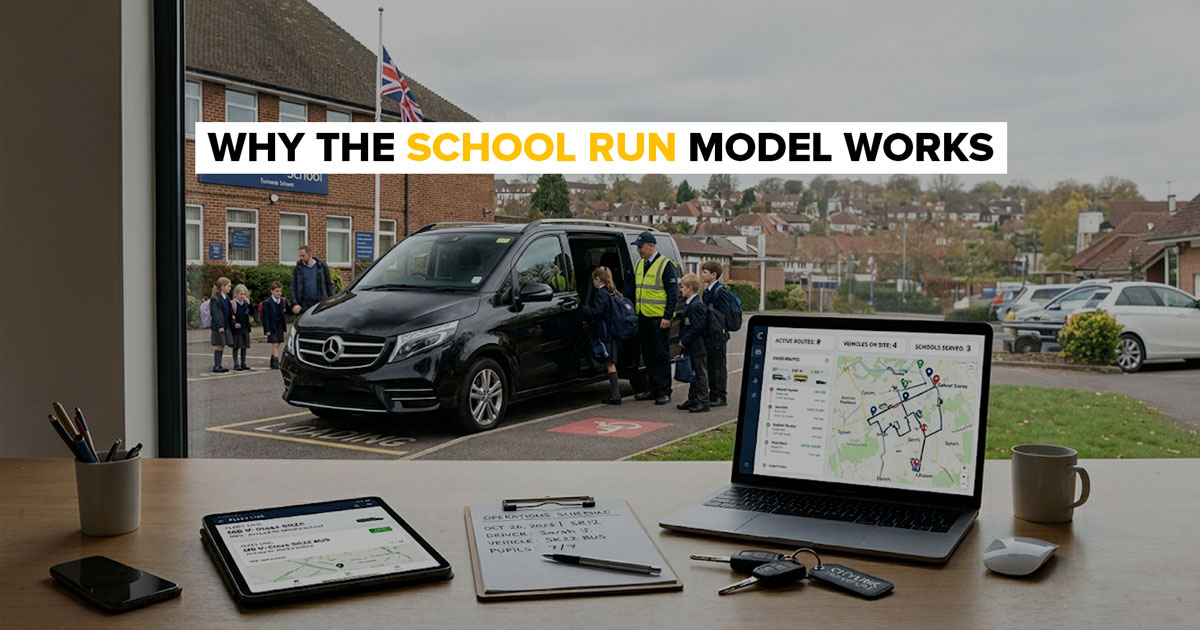
With the right dispatch system, operators can set up and manage fixed school run routes, schedule recurring daily trips automatically, handle multiple passengers and vehicles across different routes, maintain driver compliance records in one place and manage reporting for council contract renewals.
Instead of constantly reacting to scheduling challenges, operators gain a clear and structured way of running their operation.
A Segment with Strong Growth Potential
School run transport offers something many operators want predictable demand.
Routes run on the same schedule every school day. Passenger numbers are known in advance. And council contracts often run for a full academic year with the option to renew.
This consistency makes it easier to plan vehicles, drivers, and costs. It also means revenue can be forecasted term by term rather than day by day.
Despite its stability, school run work is still overlooked by many operators who focus exclusively on demand bookings. Operators who build a structured approach to school transport with proper compliance, reliable dispatch technology and strong council relationships can secure recurring contracts that competitors rarely displace.
Turning Operational Complexity into Advantage
Transporting children between home and school is not just about moving passengers. It is about keeping families reassured, councils satisfied and children safe.
With the right dispatch system in place, operators gain greater efficiency across multiple daily routes, clear visibility over every vehicle and driver, improved reliability that strengthens council relationships and a scalable service model that grows as more contracts are secured.
School run transport in the UK represents a real and growing opportunity. With the right tools behind them, operators can manage complexity, meet compliance requirements, and build a sustainable part of their business around them.
Ready to Grow Your School Run Operation?
School run transport is a stable and scalable business opportunity for UK private hire operators. With the right structure in place, school run operations create predictable term time income, support long term council contracts and build relationships that last year.
Cabsoluit’s school run dispatch solution gives operators the tools to manage fixed routes, recurring schedules and driver compliance with confidence.
→ Book a free demo to see how Cabsoluit can support your school -run operations.