



The dispatch software is very important as it automates functions such as booking, scheduling and fleet management and enables the business to expand smoothly. Through the appropriate technology, companies are able to achieve increased demand, decrease expenses, and venture into new markets successfully.
- Understanding the Challenges of Expanding Your Taxi Business
- Leveraging Technology for Seamless Expansion
- Leveraging Technology for Seamless Expansion
- Managing Logistics: Coordinating a Larger Fleet
- Scaling Responsibly and Ensuring Sustainability
- Using White-Label Taxi Apps for Seamless Expansion
- Conclusion
Understanding the Challenges of Expanding Your Taxi Business
● Expanding Operations
As your taxi business expands, the issues of operation also increase. It can be very overwhelming to manage a bigger fleet, work with more bookings and provide regular quality service in a variety of cities.
Every new market is associated with its demands and expectations that require it to be addressed effectively.
● Market Adaptation
It is also important to fit in new regulations of the city, local traditions, and competing services.
The rules and preferences of the customers are likely to vary in each location, and you will have to change your strategy to be competitive.
● Resource Management
Also, support for more drivers, vehicles and customer interaction in different regions demands effective management of resources.
Maintaining high levels of services and ease in coordination during the process of scaling is a major challenge that can be encountered by growing companies.
Leveraging Technology for Seamless Expansion
● Diversifying Your Fleet
Diversify your fleet to ensure that your customers can find what they need in terms of the type of vehicle. Cities might demand small and fuel-efficient vehicles.
Whereas the suburbs might demand bigger motor vehicles to serve the family or group.
A wide customer base is served by a variety of fleets, which guarantees satisfaction in various markets.
● Targeting New Markets
The need to explore new cities or regions necessitates study of local demand, competition and customer preferences.
Knowing the market operations will enable you to make the right decisions and approach each region differently.
It will provide an edge over competition and place your business in perspective.
● Normalizing Services Among Locations.
Standardization of performance of services in different places is paramount in the establishment of a good brand name.
The aim to have standardization in areas such as customer services, pricing and car cleanliness guarantees the customer the same experience and is likely to have their loyalty and trust as you grow to other markets.
Leveraging Technology for Seamless Expansion
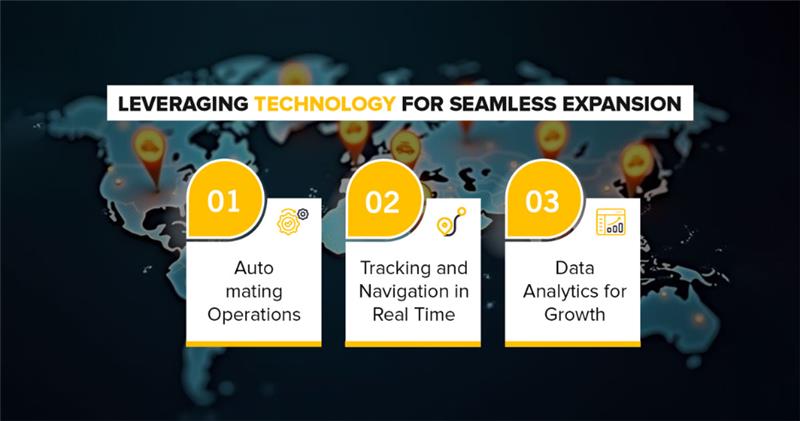
● Auto mating Operations
To run a taxi business with an increasing size, it is critical to automate important processes such as booking, dispatching, and payment systems. With technology to manage these tasks, you would be able to minimize the number of mistakes that are made manually, simplify operations, and ensure efficiency in several locations.
As an example, taxi dispatch systems based on the cloud can be easily integrated across cities, which leads to the possibility of real-time tracking, automated booking management, and easy payment processing, which makes expansion easier.
● Tracking and Navigation in Real Time
The presence of GPS-enabled applications and live tracking of the rides are essential in efficient dispatching and customer support. These technologies assist in making sure that a driver is always on the correct route.
Which minimizes the time wasted and enhances customer satisfaction. You can also guarantee timely and reliable service to the rider in various locations by giving the rider the right navigation and tracking.
● Data Analytics for Growth
The Analytics dashboard provides insightful information to the business owners regarding performance of the fleet, customer preferences, and market trends.
Given data on ride patterns, pricing, and vehicle utilization, businesses are in a good position to make sound decisions that would maximize routes, change pricing, and resource allocation.
These fact-based insights are important in fueling growth, particularly when venturing into new markets.
Managing Logistics: Coordinating a Larger Fleet
● Fleet Management Software
Businesses that are looking to expand and operate a number of fleets in various locations need powerful fleet management software. It offers central control of fleet performance thus enabling businesses to monitor the usage of vehicles, fuel consumption, and driver habits.
Fleet management software allows businesses to cut operation expenses and enhance service delivery by making the delivery routes efficient and effective use of the vehicles.
Regardless of the city or region operation, a good system will bring a lot of order in the management of the vehicles, and the productivity of the fleet will be maximized, in such a way it is easy to scale up without losing control of the activities.
● Scheduling and Dispatching
Dispatching and automated scheduling is crucial in ensuring smooth operations, particularly where a network of drivers is to be managed. Through the dispatching process being automated, the business is able to make sure that the customer relates to the closest available driver on-site, avoiding wasting time in the waiting area and enhancing service delivery.
In this system, a drop-off and pickup can occur in time bearing in mind the traffic patterns, efficient route use, and availability of drivers. Through the appropriate dispatch software, a business can achieve seamless growth in its operation even when it grows to new territories, as it will continue offering reliable services to its customers.
● Maintenance and Operational Oversight
It is also important to maintain the fleet in good condition to prevent disruption of services. By incorporating maintenance schedules into your taxi management software, the vehicles will be subjected to regular checkups and servicing and avoiding unwanted breakdowns.
This positive style of maintaining your vehicles does not only ensure that your fleet needs less time to be serviced, but they also last a longer life.
Having a definite maintenance plan incorporated into your software, businesses will not have to worry about any repairs and inspections, running the business on track and ensuring that the customers always receive reliable services.
Scaling Responsibly and Ensuring Sustainability
● Cost Control and Budgeting
The financial management in a taxi business should be tight when scaling up to ensure there is no overextension. The expenses involved in expanding like the fleet addition, upgrades of the technology and the staff can go easily out of control without being budgeted.
Cash flow management and control of costs will make certain that the business is able to expand in a sustainable manner without putting a strain on the budget.
● Regulations and Compliance
Any expansion into new locations must remain in line with the local transportation laws. The rules of fares, licensing and insurance may vary in each region.
Compliance is a way to prevent fines and inconveniences and ensure that your business will run in various locations with ease.
● Building a Sustainable Model
The temptation of rapid growth of a business is quite high, yet long-term success depends on a sustainable and profitable business model.
With emphasis on scalability, high service quality and reinvesting in efficient operations, the business will not be left in a position where it is only increasing its size but not necessarily its viability.
Using White-Label Taxi Apps for Seamless Expansion
● Benefits of White-Label Apps
The white-label taxi apps can assist the businesses to grow at an expedited pace by offering a pre-established mobile application that could be rolled out in your own name.
Businesses can easily launch an entire taxi booking and dispatch system and live in no time rather than taking the time to develop an app.
This helps in saving time, decreasing the cost of developing these services, and enables operators to concentrate on the entry of new cities, recruiting drivers and serving clients effectively.
● Customization for Local Markets
Adapting to various markets is also easy with white-label apps. Businesses can customize branding, features, prices and services to the needs of the locals without having to run on two or more separate platforms.
The flexibility guarantees a stable brand experience but with the ability to adapt to local regulations, customer preferences, and demand in the market and thus expansion becomes easier and more manageable.
Conclusion
t is a combination of planning, technology, and operations management to grow a taxi business to the extent of a local and international business. It becomes less challenging to run fleets and adjust to new markets and meet the quality of services when businesses are based on automation and data-driven decisions.
Businesses must begin using technology to facilitate scalability so as to proceed with confidence. The development of high-tech taxi dispatch systems will allow to optimize the procedures, enhance control, and provide easy development of operations in several cities.